

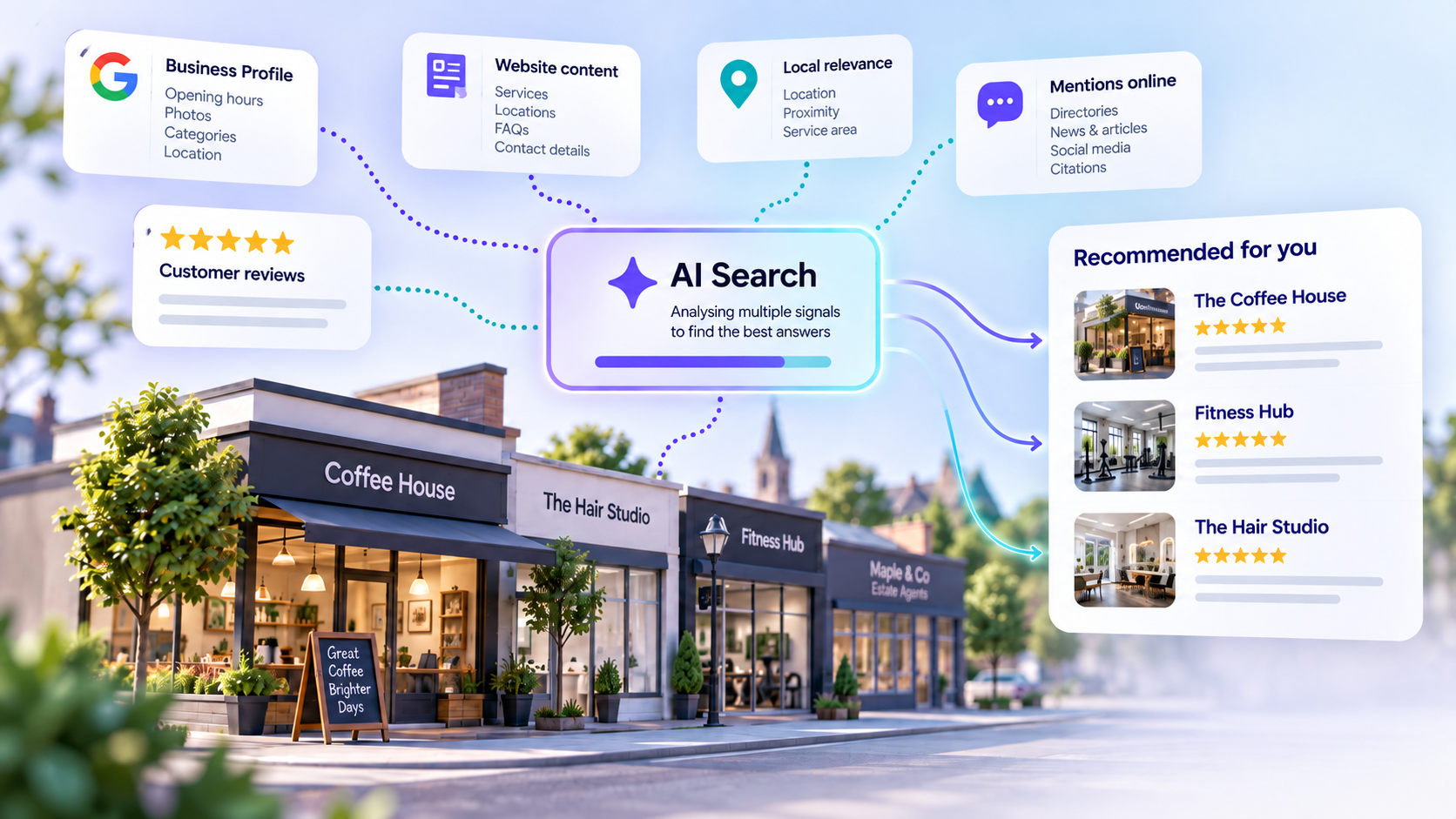
When someone asks an AI assistant for a local recommendation, the answer can feel remarkably simple: a short list of businesses, perhaps with a sentence explaining why each might be suitable. Behind that apparently simple response, however, sits a much harder problem. The system has to work out which businesses actually exist, what they do, where they operate, whether the available information is trustworthy and whether recommending them would genuinely help answer the user's question.
For local businesses, that changes the visibility challenge. It is no longer enough to think only about where a website ranks for a keyword. Increasingly, the question is whether search engines and AI-powered services can understand the business well enough — and find enough supporting evidence — to include it confidently in an answer.
The important caveat
Google documents how its local search system works at a high level, but AI platforms do not publish a precise formula explaining how they choose local businesses for recommendations. Some of what follows is therefore based on confirmed search guidance, while other parts reflect observable practice and industry research rather than a published AI ranking algorithm.
The recommendation problem is different from the ranking problem
Traditional search encourages us to think in terms of rankings. A person searches for a service, Google returns a set of results, and businesses compete for visibility within those results.
AI-powered search can behave differently. Instead of presenting ten links and asking the user to investigate, it may attempt to synthesise the available information and offer a direct answer. A user might ask:
“Which accountant near Christchurch would be suitable for a small limited company that wants cloud accounting and regular management information?”
That query contains several decisions at once. The system needs to identify local accountants, understand which services they offer, interpret the location, assess whether the information appears current and credible, and then decide which businesses are relevant enough to mention.
That is why visibility in AI search is better understood as a confidence problem rather than simply a ranking problem.
What Google already confirms about local visibility
We do have a firm starting point. Google publicly says that its local results are primarily based on three factors: relevance, distance and prominence.
Relevance
Relevance is about how closely a business matches what somebody is searching for. A complete Google Business Profile helps Google understand what the business does, which services it provides and when it is appropriate to surface it.
Distance
Distance reflects how far the business is from the location involved in the search. Businesses have limited control over this factor, although accurate location and service-area information still matters.
Prominence
Prominence relates broadly to how well known or established a business appears to be. Google explicitly states that more reviews and positive ratings can help local ranking, and that positive reviews and helpful responses can help a business stand out.
Local visibility starts with information Google can understand
Before worrying about sophisticated AI optimisation, a local business should make sure that its basic identity, category, services, opening hours, contact information and location are complete and consistent.
Four layers of local AI visibility
At Wysper Labs, I find it useful to think about local AI visibility as four connected layers: Trust, Reputation, Authority and Confidence.
They are not four independent tricks. They build on each other. Weak foundations make everything above them harder.
1. Build Trust — can the business be clearly identified?
The first requirement is surprisingly basic: the system needs to understand that the business exists and what it actually is.
That means maintaining a complete and accurate Google Business Profile, using the real business name, choosing appropriate categories, listing services accurately and keeping opening hours and contact information current.
Consistency matters as well. If the business name, address, telephone number or service descriptions differ substantially between the website, Google Business Profile and third-party listings, the overall entity becomes less clear.
A useful way to think about entity clarity
If several independent sources describe the same organisation in broadly the same way, it becomes easier for machines as well as people to understand exactly which business those sources are referring to.
2. Build Reputation — what do customers say about the business?
Reviews play two roles at once. They can influence whether a potential customer feels comfortable choosing a business, and they also provide search systems with a substantial body of third-party information.
Google itself confirms that reviews and positive ratings can contribute to local prominence. Beyond the headline star rating, review content can also contain useful context about the services customers actually received.
For example, a plumbing business may describe itself as providing emergency boiler repairs. If customers repeatedly mention emergency call-outs, boiler repairs and the areas served, those reviews provide independent evidence that supports the business's own description.
Recency matters from a human perspective too. A strong historic reputation is valuable, but a steady flow of current feedback gives customers stronger evidence that the business remains active and continues to deliver.
3. Build Authority — does the website explain the business properly?
A Google Business Profile can only communicate so much. The business website provides the space to explain services in depth, answer customer questions, describe processes, clarify pricing and demonstrate genuine subject knowledge.
This is where many otherwise credible local businesses create an unnecessary visibility gap. Their website may consist of a homepage, a short services list and a contact form. A human who already knows the company might understand enough, but a search or AI system has relatively little material from which to build a detailed picture.
Strong service pages, useful FAQs, clear pricing information where appropriate, structured data and well-attributed expert content all make the business easier to interpret.
More content is not automatically better content
Publishing dozens of thin pages does not create meaningful authority. The stronger approach is to publish accurate, useful material that answers real questions and makes the business's expertise demonstrable.
4. Build Confidence — does the wider web support the story?
The final layer is external corroboration.
A business can say almost anything about itself on its own website. Independent sources are therefore valuable because they help confirm that the organisation is what it claims to be.
Depending on the sector, those sources might include directories, trade associations, local press, professional bodies, partners, community organisations, review platforms or other reputable websites.
This is particularly relevant to AI-powered recommendation systems because they may draw information from a much wider range of sources than a business's own website alone.
Entity clarity, relevance and corroboration
Another useful model is to reduce the problem to three questions.
Entity clarity: does the system know who you are?
The business needs a clear and consistent identity across the web. Names, locations, services and descriptions should line up sufficiently for different sources to be connected to the same organisation.
Relevance: are you a good match for this particular question?
AI recommendations are context dependent. Being a highly regarded restaurant does not make a business relevant to somebody asking for a nearby accountant. Even within the same industry, the query may specify location, service type, budget, opening hours or specialist requirements.
Clear service information therefore matters because it gives the system more evidence with which to make that match.
Corroboration: does anyone else support your claims?
Third-party evidence can reduce uncertainty. Reviews, credible directory profiles, professional listings, citations and genuine mentions all provide signals outside the business's own website.
None of these individually guarantees an AI recommendation. Collectively, however, they can create a much clearer and more defensible picture of the business.
Why reviews are becoming even more strategically important
Reviews are sometimes treated as a conversion tool that sits at the very end of the customer journey: somebody finds the company, checks the star rating and then decides whether to make contact.
That remains important, but it understates what reviews represent. They are also one of the largest collections of independently written, business-specific information available online.
Review text can describe services, locations, staff members, customer experiences, strengths and recurring problems. In aggregate, that creates a rich external picture of how the business actually operates.
This does not mean businesses should manipulate review language or tell customers what to write. Reviews should remain genuine and freely expressed. The strategic objective is much simpler: make it easy for real customers to leave honest feedback and maintain a consistent, compliant review-acquisition process.
Your website still matters — but its role is changing
The rise of AI search does not make business websites irrelevant. If anything, it increases the value of having a site that explains the organisation clearly.
A useful website can provide detailed service information, geographical context, frequently asked questions, pricing, credentials, original analysis and evidence of expertise that simply will not fit into a Business Profile.
Structured data can also help machines interpret the information on the page. Appropriate Organisation, LocalBusiness and other valid schema can make relationships more explicit.
What structured data cannot do is manufacture authority. Adding schema does not guarantee ranking, citation or recommendation. It helps describe information that should already be accurate and useful.
What should a local business actually do?
For most smaller businesses, the practical answer is not to chase every new AI optimisation tactic. The stronger approach is to improve the underlying evidence that search systems and customers already rely on.
- Complete and verify the Google Business Profile.
- Keep the business name, address, telephone number and core service information consistent across important platforms.
- Build a steady and compliant process for generating genuine customer reviews.
- Respond helpfully to reviews and pay attention to recurring themes in the feedback.
- Create substantive service pages that explain what the business actually does.
- Answer real customer questions through useful FAQ and educational content.
- Make authorship and expertise clear where specialist content is published.
- Earn accurate third-party listings and credible mentions rather than relying only on self-published claims.
- Monitor how the business appears across both conventional search and representative AI queries.
The broader principle
The objective is not to trick an AI system into mentioning your business. It is to build enough clear, consistent and credible digital evidence that mentioning the business becomes an understandable recommendation.
What we still do not know
It is important not to overstate the certainty around AI search. OpenAI, Google, Anthropic, Perplexity and other providers continue to develop their search and recommendation systems rapidly.
They do not publish a universal list of local-business ranking factors, and different products may retrieve, interpret and synthesise information in different ways.
That means nobody can credibly promise that adding a particular schema type, earning a certain number of reviews or publishing a specified number of articles will cause ChatGPT or another AI platform to recommend a business.
What businesses can do is reduce ambiguity. They can make their identity clearer, their reputation more visible, their expertise easier to assess and their claims easier to corroborate.
The businesses easiest to recommend will usually be the easiest to understand
AI search is new, but many of the foundations of visibility are not.
Accurate business information, a strong reputation, useful website content and credible third-party evidence have long mattered to customers and search engines. AI-powered discovery gives those signals a new context because systems are increasingly being asked not merely to retrieve information, but to interpret it and make recommendations.
For local businesses, the practical goal is therefore not simply to “rank for AI.” It is to become a business that can be clearly identified, confidently understood and credibly supported by the information available across the web.
That is the principle behind the Wysper Labs approach to AI visibility: build trust first, then reputation, authority and finally the wider confidence that makes a business easier to recommend.