

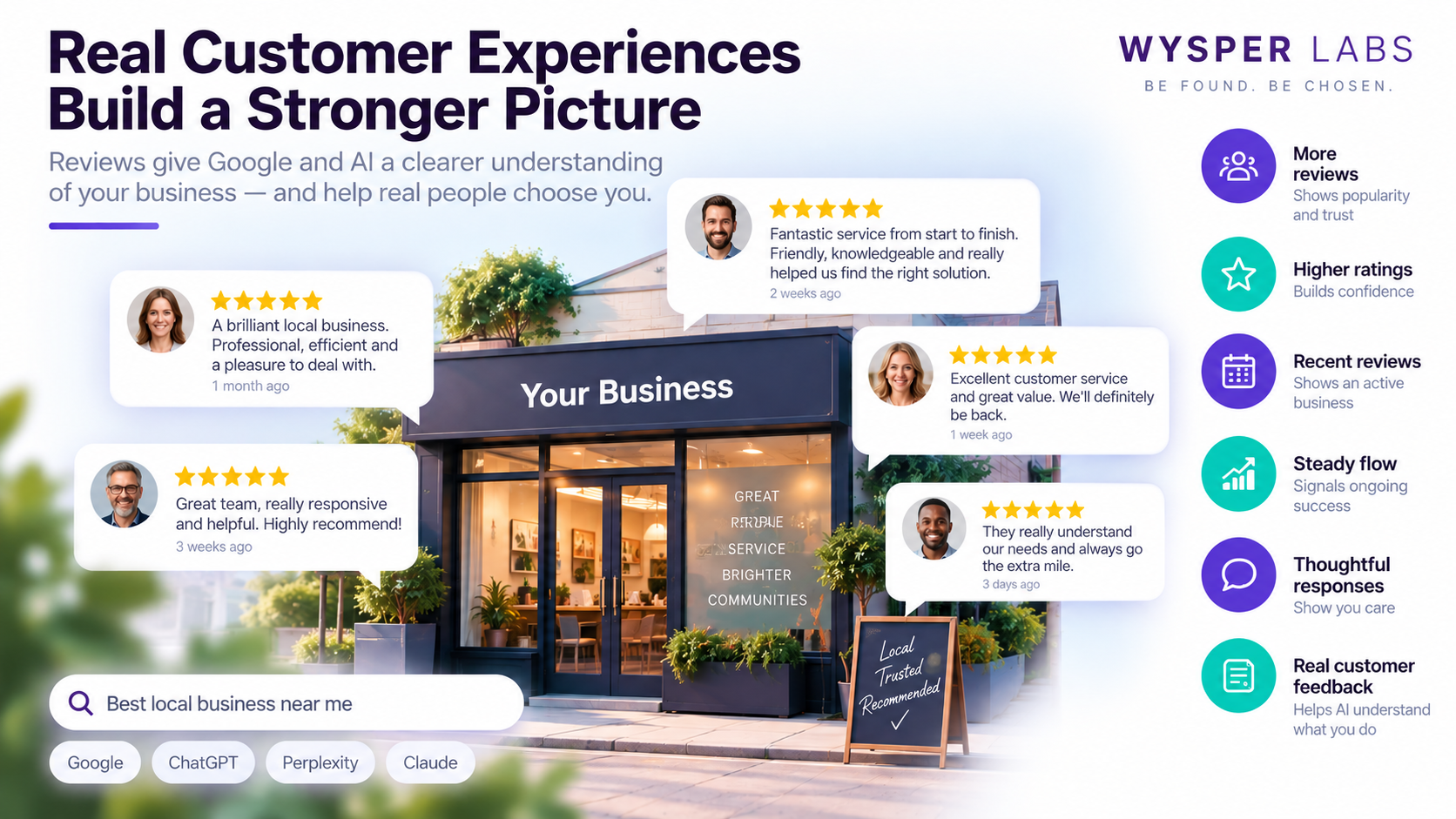
For years, the most visible feature of online reviews has been the star rating. A business with 4.8 stars appeared stronger than one with 3.9, and the logic seemed straightforward.
But the rating is only the summary. Underneath it sits something much more useful: hundreds, sometimes thousands, of individual customer accounts describing what the business actually did, which services people used, where they travelled from, which staff members helped them, what went well and, occasionally, what went wrong.
In a search environment increasingly shaped by systems that try to understand and summarise information rather than simply return a list of links, that body of evidence deserves more attention.
The important distinction
Google publicly confirms that review count and positive ratings can contribute to local search visibility. AI providers do not publish an equivalent formula explaining exactly how review data affects local recommendations. Where this article discusses reviews in an AI-search context, it should therefore be understood as practical interpretation rather than a published AI ranking rule.
Reviews have moved beyond the star rating
A star rating is useful because it compresses a large amount of feedback into one simple number. That simplicity is also its limitation.
Two businesses can both have a 4.8 rating while presenting very different levels of evidence.
One may have twelve reviews collected over six years. Another may have 420 reviews, with new feedback arriving every week and customers repeatedly describing the same services and strengths.
The headline number is similar. The underlying evidence is not.
For a prospective customer, the second business provides more information from which to judge whether the experience is likely to match their needs. It shows not just whether people were satisfied, but whether the business is active, whether the experience appears consistent and whether recent customers are still reporting similar outcomes.
That is why a strong review profile should be thought of as a body of customer evidence rather than simply a score.
What Google actually says about reviews
There is no need to speculate about whether reviews matter to Google's local search system. Google says that local results are primarily based on relevance, distance and prominence, and explicitly states that more reviews and positive ratings can help a business's local ranking.
Google also encourages businesses to respond to reviews and says that positive reviews and helpful replies can help a business stand out.
What Google does not publish is a precise formula.
There is no official rule saying that 100 reviews will move a business above a competitor with 80, nor that improving a rating from 4.6 to 4.7 will produce a particular ranking change. Distance, relevance, competition and many other factors remain involved.
Reviews are part of local prominence
Review quantity and positive ratings can contribute to local ranking, but they operate as part of a wider local search system rather than as a standalone formula.
Why reviews become interesting in an AI-search world
AI-powered search introduces a different kind of information problem.
Instead of simply returning a directory of local businesses, an AI system may be asked to interpret a more detailed request:
“Can you recommend a family-friendly restaurant near me that is good with allergies and has consistently good service?”
A business's own website may say that it is family friendly. It may state that dietary requirements are accommodated and that service is excellent.
Those are useful claims, but they are still claims made by the business itself.
Reviews provide a different type of information because customers may independently describe taking children there, receiving help with allergies, dealing with particular staff members or having an unusually good or poor service experience.
That does not prove that a particular AI platform will use those reviews in a particular way. What it does mean is that reviews constitute a substantial source of third-party, business-specific information that can add context to the digital picture of a company.
Reviews are corroboration, not just promotion
A business can describe its own service. Reviews can show whether customers independently describe experiencing that service in broadly the same way.
Five dimensions of a healthy review profile
Businesses often focus almost entirely on average rating. A healthier view is to consider several characteristics together.
1. Volume
Review volume matters because a larger body of feedback provides more evidence.
A perfect 5.0 rating based on three reviews tells a customer less than a 4.8 rating supported by hundreds of genuine customer experiences.
There is no universal number of reviews every business should aim for. Expectations differ enormously between sectors, locations and competitors. A village tradesperson and a city centre restaurant should not be judged by the same arbitrary threshold.
The useful comparison is therefore not simply “How many reviews do we have?” but “Does our review base provide enough current evidence relative to the market in which we operate?”
2. Rating
Rating still matters. It is one of the quickest signals customers use when comparing businesses.
But businesses should be cautious about pursuing a perfect score at all costs. A genuine reputation will normally contain some variation, and the operational lesson from weaker feedback can be more valuable than maintaining an artificially flawless appearance.
If the rating is consistently weak, the answer is not simply to generate more review requests. The priority should be to understand what customers are telling the business and address recurring service problems.
3. Recency
Reviews are time-sensitive evidence.
Twenty excellent reviews from four years ago may demonstrate that a business once satisfied its customers. They tell us much less about the experience being delivered today.
Recent reviews show that customers are still using the business and still reporting their experiences.
This is one reason a steady review process is usually stronger than a short campaign that generates a burst of feedback and then stops.
4. Consistency
A healthy review profile normally grows as a consequence of normal business activity.
If a company serves customers every week but receives virtually no reviews for months and then suddenly gains a large cluster, the visible reputation does not reflect the rhythm of the underlying business particularly well.
The goal is not to engineer an artificial review velocity. It is simply to build review requests naturally into the customer journey so that genuine feedback arrives on an ongoing basis.
5. Responses
The review does not have to be the end of the conversation.
A useful response acknowledges the customer, demonstrates that the business is listening and, where necessary, explains how an issue will be addressed.
Responses also give future customers additional information about how the organisation communicates when things go well and when they do not.
Why 4.9 stars and twelve reviews isn't necessarily as impressive as it looks
Imagine two local businesses.
Business A has a 4.9 rating from twelve reviews. Its most recent review was eight months ago.
Business B has a 4.7 rating from 185 reviews. It receives several new reviews each month and responds personally to most of them.
Which has the stronger reputation?
There is no mathematical answer that applies to every customer. Some people may simply prefer the higher headline score.
But Business B provides considerably more current evidence. Prospective customers can read a wider range of experiences, see how recently people have used the company and observe how the business engages with feedback.
This is why treating review strength as a single number can be misleading.
Rating answers only one question
A fuller picture considers rating alongside volume, recency, consistency, review content and business responses.
Recency changes the picture
A business is not a static object.
Staff change. Ownership changes. Processes improve. Service quality can rise or fall. New products are introduced and old ones disappear.
That makes the date of a review meaningful.
Consumer research cited in the Wysper Labs Knowledge Base consistently shows that people pay attention to recent reviews. The exact percentages come from US consumer surveys and should not automatically be treated as UK figures, but the underlying behavioural point is useful: customers want evidence that still reflects the business they are considering today.
Recency is therefore not about chasing reviews for the sake of an algorithm. It is about keeping the visible reputation aligned with the current business.
Review responses are part of the evidence too
Review management is sometimes divided into two tasks: generating reviews and dealing with negative ones.
That misses an opportunity.
Responses to positive reviews can reinforce appreciation and demonstrate that feedback is genuinely noticed. Responses to critical reviews can show professionalism, accountability and a willingness to resolve problems.
The important word is genuinely.
A stream of identical replies such as “Thank you for your wonderful review, we appreciate your custom” may technically count as responding, but it tells the reader very little.
A short personal response that refers naturally to the customer's experience is usually more useful.
Respond for the next customer too
A review response is addressed to one customer but may be read by hundreds of future customers. Treat it as part of the public record of how the business behaves.
What customers actually say matters
The written content of reviews can reveal far more than the star rating.
Consider an estate agent whose website says it provides responsive communication, local knowledge and support throughout the sales process.
If customer reviews independently and repeatedly mention quick replies, detailed local advice and good communication during difficult transactions, those accounts support the company's own description.
Equally, if reviews repeatedly complain that calls are not returned, that is useful evidence for the business itself. Reputation management should include learning from patterns in customer feedback, not merely collecting favourable quotations.
Review text may also naturally include service names, locations, problems solved, staff names and specific elements of the experience.
Businesses should not script those details or tell customers which keywords to use. Their value comes precisely from being independently expressed.
Don't optimise reviews for machines
As businesses become more aware of AI search, an obvious temptation is to try to engineer review content for machines.
That is the wrong direction.
Reviews are valuable because they represent genuine customer evidence. The more a business manipulates that evidence, the less trustworthy it becomes.
A sensible review programme should therefore avoid:
- fake reviews written by staff, agencies or people who were not genuine customers;
- purchasing reviews or arranging artificial review exchanges;
- telling customers what rating they should give;
- supplying scripted phrases or keywords for customers to copy;
- offering rewards in exchange for favourable feedback;
- selectively directing happy customers to public review platforms while diverting dissatisfied customers elsewhere.
In the UK, fake reviews are also a regulatory issue. The Digital Markets, Competition and Consumers Act strengthened enforcement around fake and misleading review practices, so authenticity is not merely a marketing preference.
The safest principle is straightforward: ask genuine customers fairly, make the process easy and allow them to describe their experience in their own words.
A practical review strategy for local businesses
Review management does not need to become complicated.
For most local businesses, a reliable system can be built from a handful of repeatable behaviours.
- Choose a natural request point. Ask after the service has been delivered or when the customer has had a reasonable opportunity to experience the result.
- Ask consistently. Avoid relying on staff remembering only occasionally. Build the request into the normal customer process.
- Make leaving a review easy. Use a direct review link, QR code or appropriate automated follow-up rather than asking customers to search for the listing themselves.
- Ask for an honest review, not a positive one. The purpose is to capture genuine customer experience.
- Respond to feedback. Personal, useful replies demonstrate that customers are being heard.
- Watch the patterns. Repeated praise can reveal genuine strengths. Repeated criticism can expose operational problems worth fixing.
- Keep the process running. A steady flow of current feedback is usually more useful than occasional review campaigns.
- Compare your position sensibly. Review expectations vary by sector and location, so compare your visible reputation with genuine local competitors rather than chasing an arbitrary national benchmark.
The right objective
Do not build a review system merely to accumulate stars. Build one that keeps an accurate, current and independently supported picture of the customer experience visible online.
Reviews are one part of the wider AI visibility picture
Reviews should not be treated as a shortcut to AI visibility.
A business still needs clear core information, a complete Google Business Profile, useful website content and credible third-party evidence around the web.
Reviews fit within that wider picture because they add something the business cannot create on its own: independent descriptions of real customer experiences.
That makes them particularly valuable at the reputation stage of the Wysper Labs AI Visibility framework.
The stronger objective is therefore not “get reviews so AI will recommend us.”
It is to make sure that when customers, search engines or AI-powered systems encounter the business online, they find a current and credible body of evidence supporting what the business says about itself.
Build a reputation that remains useful beyond the star rating
Online reviews have not stopped being a conversion tool. Customers will continue to look at ratings and read feedback before deciding whom to contact.
But the value of reviews is broader than that.
They create an accumulating record of customer experience: how recently the business has been used, which services people mention, what customers repeatedly value and how the company responds when expectations are not met.
As local discovery becomes increasingly conversational and information is interpreted across multiple sources, that independent evidence becomes strategically more interesting.
No responsible business should manufacture reviews for an algorithm, and nobody can promise that collecting a particular number will cause an AI platform to recommend a company.
The better strategy is much more durable: deliver a good experience, ask genuine customers consistently, make it easy for them to share their views, respond thoughtfully and allow an authentic reputation to build over time.
That creates something useful whether the next customer finds the business through Google Maps, a conventional search result, an AI assistant or a channel that has not yet emerged.